What is EMC and why does it matter for CE marking?
Electromagnetic compatibility (EMC) means two things: a device must not disturb other devices beyond the permitted level (emissions), and it must itself be robust enough against usual disturbances (immunity).
In the EU this is governed by the EMC Directive 2014/30/EU, in Switzerland by the Ordinance on Electromagnetic Compatibility (VEMV, SR 734.5), which is aligned with the EU. Without meeting the EMC requirements there is no declaration of conformity and no CE marking.
What is an EMC pre-compliance test?
A pre-compliance test is an EMC measurement you run yourself during development, with affordable equipment instead of an accredited test lab. The goal: estimate whether your device will pass the formal test, and find problems while they are still cheap to fix.
Pre-compliance or accredited test lab?
Both have their place:
- ›Accredited lab: calibrated chamber, defined distances, full limit lines and a traceable result. Expensive, scheduled, with a final pass or fail.
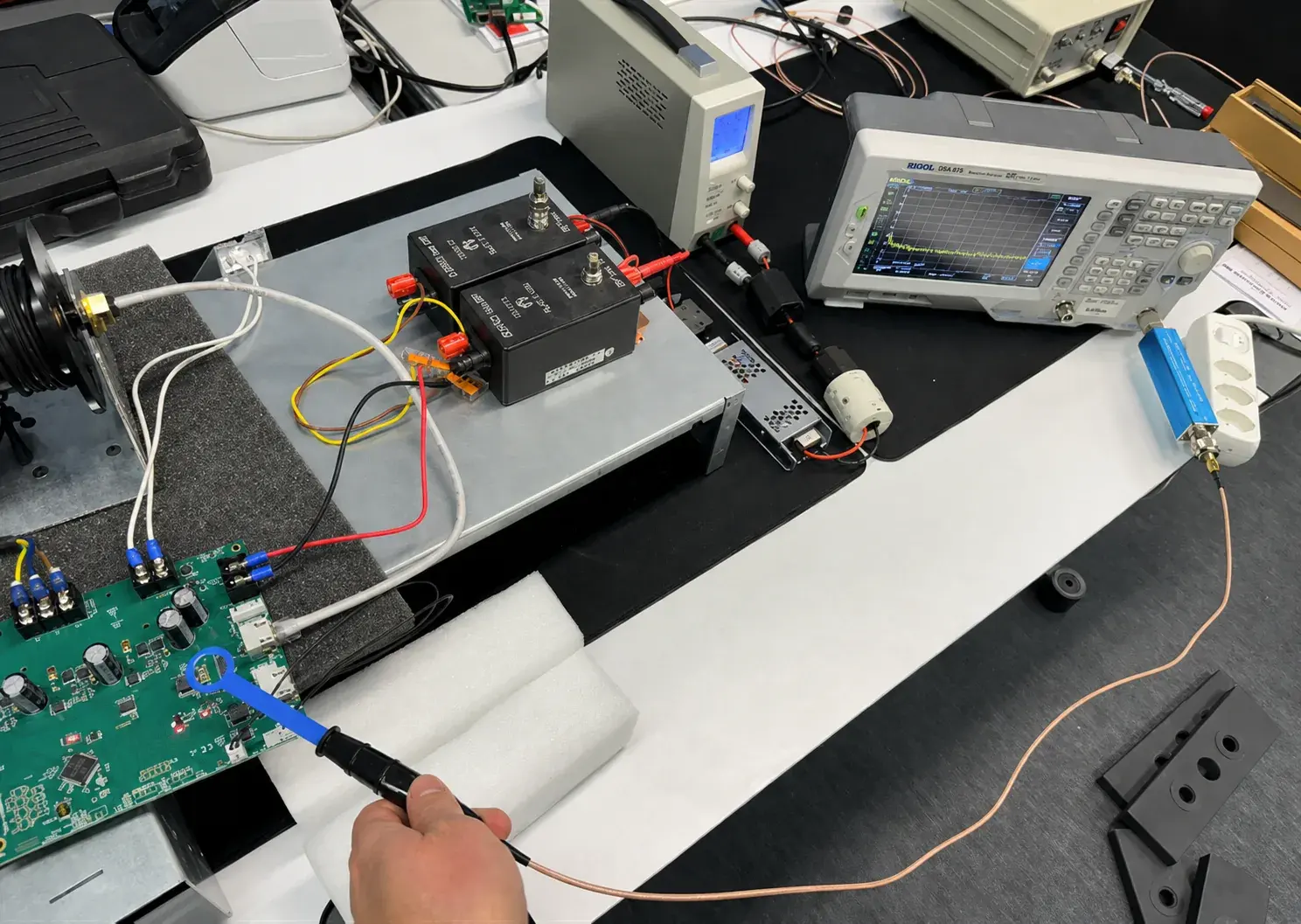
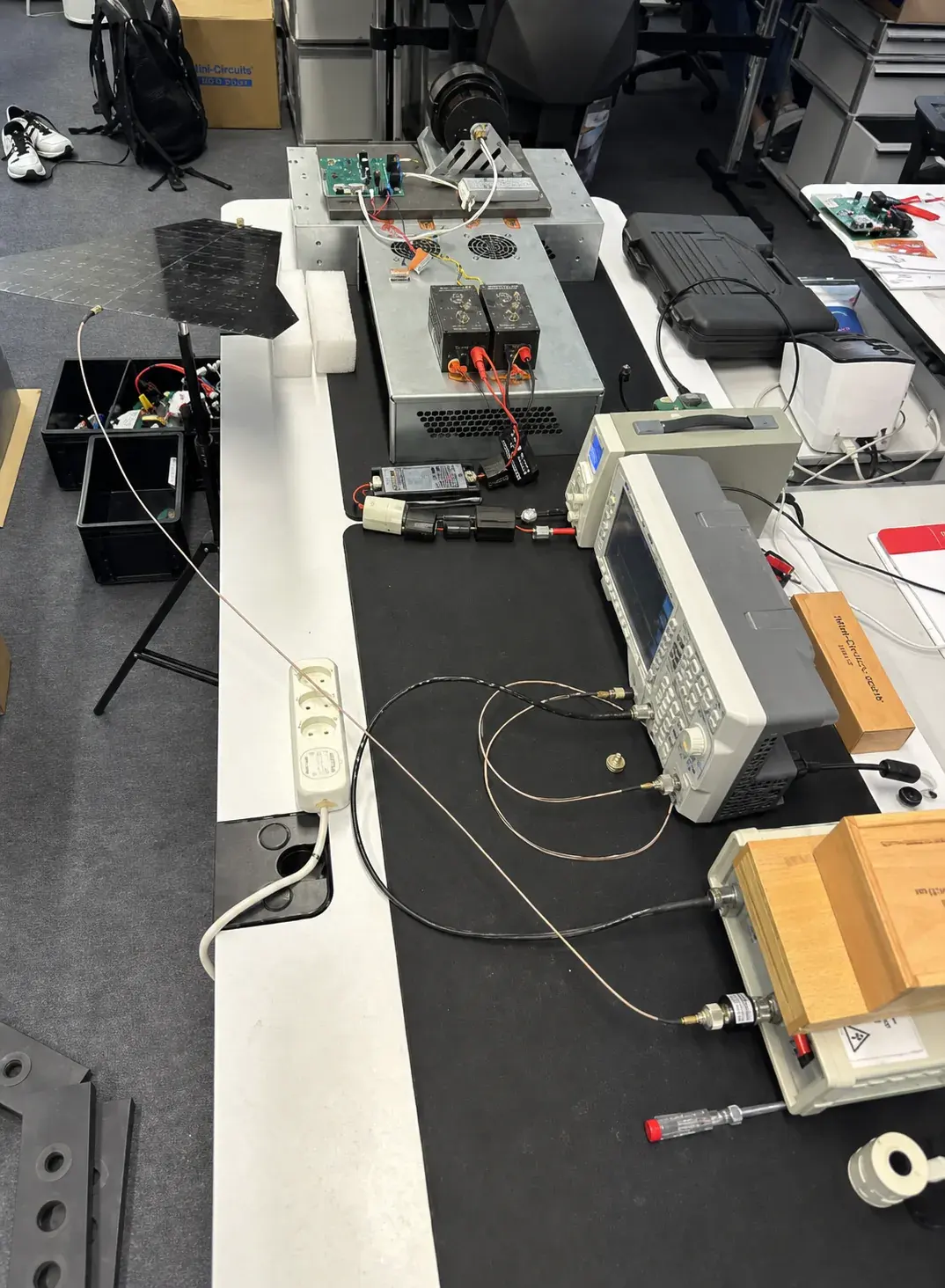
- ›Pre-compliance on your own bench: affordable instruments, relative and estimated results, repeatable any time after every design change.
Pre-compliance does not replace the test. It makes sure you go to the lab with high confidence.
Which EMC standard applies to my product?
The most specific standard always applies:
- ›Product standard for exactly one product type, for example EN 61800-3 for adjustable speed drives.
- ›Product family standard for a group of similar products, for example EN 55014-1/-2 for household appliances and power tools, EN 55032/55035 for multimedia or EN 55011 for ISM equipment.
- ›Generic standard only if no product or product family standard fits: EN 61000-6-1/-6-3 for residential and commercial, EN 61000-6-2/-6-4 for industrial environments.
- ›Basic standards only describe the test methods, for example CISPR 16 for emissions and EN 61000-4-x for immunity.
Equipment on the public mains up to 16 A per phase also needs EN 61000-3-2 (harmonics) and EN 61000-3-3 (flicker).
Class A or Class B?
What matters is where and how your product is connected. Class B applies to residential, commercial and light industry on the public low-voltage grid, with strict emission limits. Class A applies to industry with its own transformer, with emission limits about 10 dB higher but higher immunity requirements.
Rule of thumb: if your product can be plugged into a normal household socket, design it for Class B.
Which measurements are part of a pre-compliance test?
- ›Conducted emissions, typically 150 kHz to 30 MHz, with a LISN and spectrum analyzer.
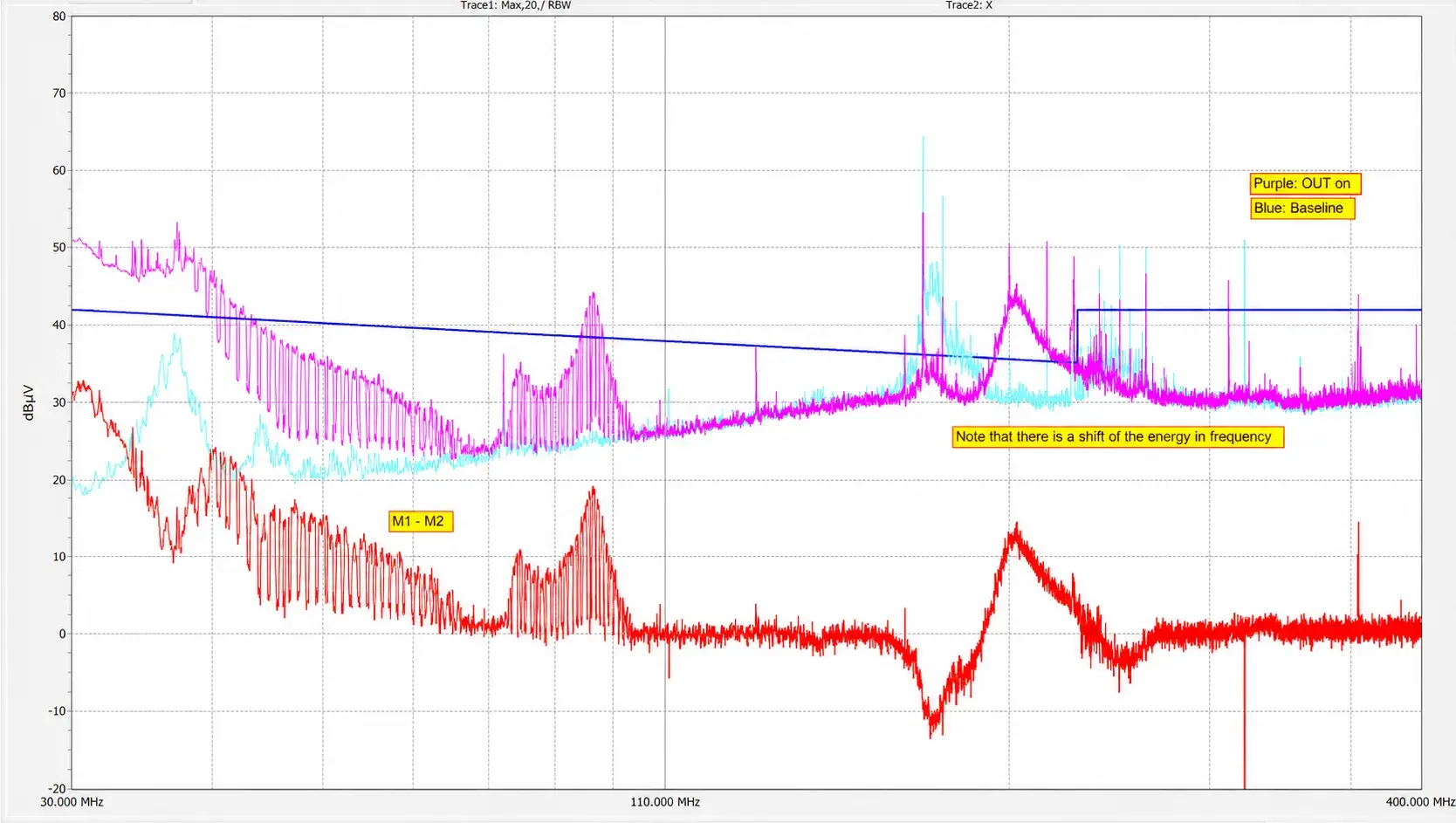
- ›Radiated emissions, typically 30 MHz to 1 GHz, estimated on your own bench with an RF current clamp.
- ›RF immunity modelled on EN 61000-4-3, with a signal source, amplifier and antenna.
- ›Near-field probing: not a standard test, but the tool to find noise sources on the board.
How much margin to the limit do I need?
For pre-compliance, plan at least 6 dB of margin below the limit. That covers the measurement uncertainty of a simple bench.
In practice you measure with the peak detector first, because it is the fastest and always gives the highest value. If the peak stays below the average limit with margin, you are on the safe side. If not, you check the critical frequencies additionally with average and quasi-peak measurements.
Why do brushed motors cause EMC problems so often?
When commutating, small sparks form at the brushes. This brush sparking generates broadband noise that radiates from the motor cables and is fed back into the supply. Without countermeasures, devices with brushed motors therefore often exceed the limits.
Effective measures are capacitors directly at the motor terminals, common-mode chokes and ferrites in the supply lines, a layout with small current loops and good shielding with wide-area bonding to the housing.
How much does your own EMC test bench cost?
A complete pre-compliance bench with spectrum analyzer, LISNs, RF current clamp, near-field probes plus amplifier and antenna costs around 3,000 to 7,000 CHF depending on the configuration. That is a fraction of an own test chamber and often pays off by saving a single repeat lab session.
Does the course replace testing in an EMC lab?
No. For the declaration of conformity you still need the test to the standard. The course makes sure you go to the lab with a device that is very likely to pass the first time, and that you know where to start yourself if there is a problem.
How does the course work and can I bring my own device?
The course takes about four hours, with live measurements on a real device. You take home a script and an equipment list.
You are welcome to bring your own device, ideally one that causes problems or for which you already have a lab result. Get in touch beforehand so we can prepare the setup.